As heavier rainfall pushes flood risk beyond mapped zones, Flow Flood shares three ways agents can raise coverage with every property owner.
SAN FRANCISCO, CA, UNITED STATES, August 17, 2026 /EINPresswire.com/ — The places where floods happen are changing faster than the maps many property owners rely on. NOAA reports that extreme precipitation events have grown more frequent across most of the United States since the early 20th century, with the Northeast alone experiencing roughly a 55% increase in heavy-rain events in recent decades. As heavier downpours reach communities well beyond mapped high-risk zones, Flow Flood, the private flood insurance platform built by agents for agents, is encouraging independent insurance agents to make flood coverage a routine conversation with every property owner, not only those required to carry it.
THE WIDENING FLOOD PROTECTION GAP
Flooding is the most common and costly natural disaster in the United States, according to FEMA, and its reach is broad: over the past 20 years, 99% of U.S. counties have experienced a flood event, the National Flood Insurance Program (NFIP) reports. Yet flood damage is excluded under standard homeowners and renters insurance policies, according to the Insurance Information Institute (Triple-I), leaving many property owners exposed without realizing it.
That exposure is not confined to coastal or riverfront property. From 2014 to 2024, nearly one-third of NFIP flood insurance claims (29%) came from areas outside designated high-risk flood zones, according to FloodSmart.gov. And the cost of even minor flooding is significant: FEMA notes that just one inch of water can cause $25,000 in damage to a home.
Flow Flood characterizes the gap this way (Flow Flood perspective): flood maps describe where coverage is federally required, not the full picture of where water can go. As rainfall patterns shift, the distance between where flood risk actually exists and where coverage is actually in place continues to widen. Closing that gap, the company believes, begins at the point of sale, in the conversations agents have with their clients.
On public policy, Flow Flood takes an intentionally even-handed view (Flow Flood position): property owners are best served when a stable National Flood Insurance Program and a healthy private flood market operate side by side, giving consumers real options to compare. The company’s focus is not on reforming any program, but on helping agents put those options in front of clients.
THREE WAYS AGENTS CAN HELP
Flow Flood recommends three practical steps agents can take to serve clients well as flood risk evolves:
1. Raise flood coverage with every property owner. Because a meaningful share of losses occurs outside high-risk zones, the conversation is relevant to clients in nearly every ZIP code, regardless of whether coverage is mandated.
2. Present options side by side. Showing private flood quotes alongside an NFIP rate indication lets clients weigh price and coverage and make an informed choice, rather than defaulting to no coverage at all.
3. Document the offer. Noting when flood coverage was presented, and if applicable declined, protects both the client’s understanding and the agency, an increasingly valuable safeguard as flood events reach new areas.
Flow Flood emphasized that these steps are not a criticism of agents, whose work is complex and time-constrained, but a recognition that the right tools make a proactive flood conversation practical at scale.
“Agents are the front line of flood protection, and the vast majority want to have this conversation; they just need it to be fast and clear,” said Abbe Sultan, Co-Founder of Flow Flood. “When an agent can show a client their private options and an NFIP rate indication side by side in a couple of minutes, the flood conversation stops being a burden and becomes a natural part of every policy review.”
HOW FLOW FLOOD SUPPORTS THE CONVERSATION
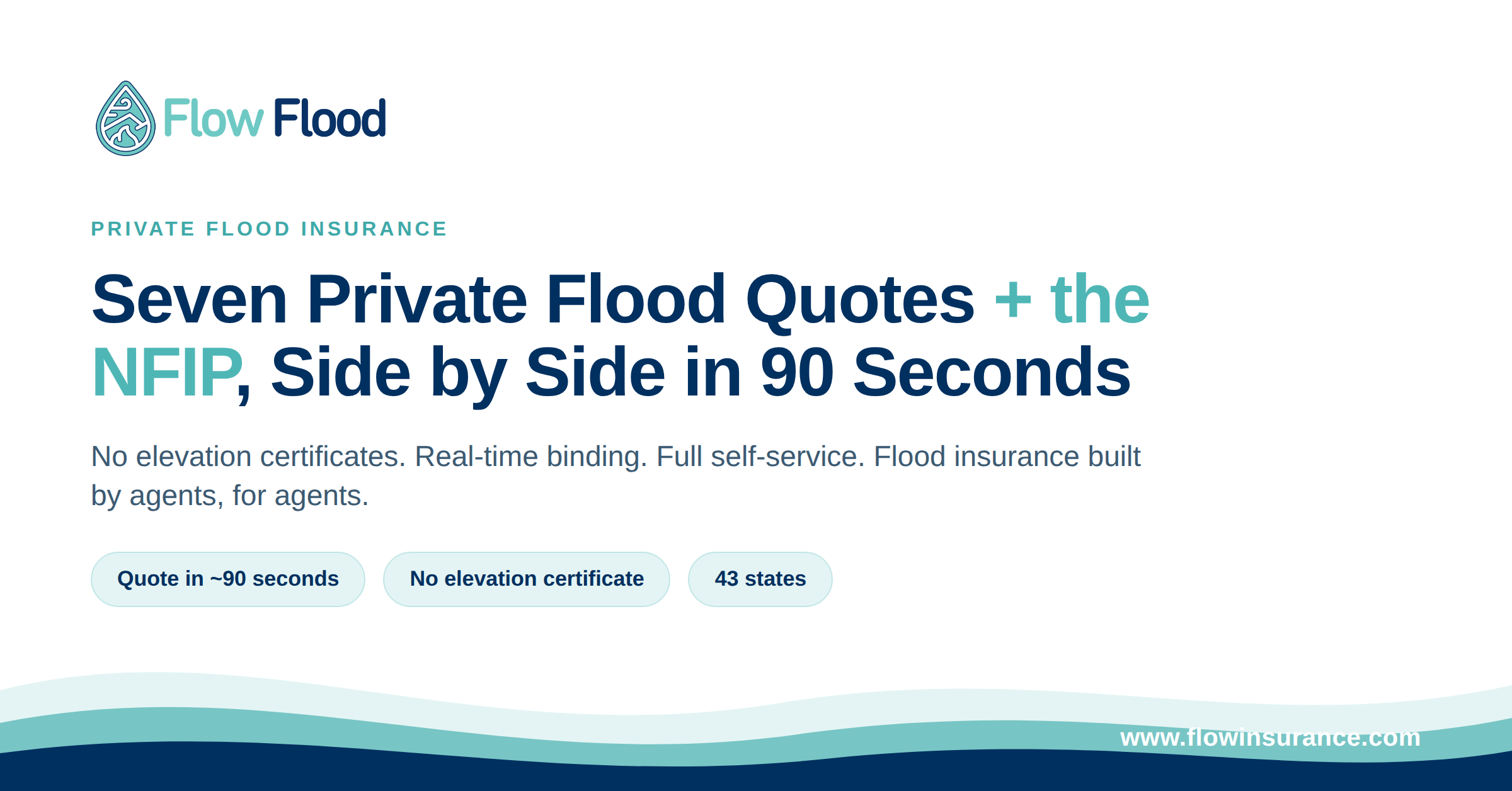
Flow Flood was founded by former independent agency owners to remove friction from quoting, binding and servicing flood insurance. Within a single environment, agents can compare seven private flood options alongside an NFIP rate indication, with quotes returned in as little as 90 seconds and no elevation certificate required thanks to advanced mapping technology. Agents can bind in real time and manage endorsements, mortgagee changes and renewals themselves, keeping them in control of the client relationship. Coverage is available across 43 states for residential, commercial and CBRA properties.
“Our goal is to make flood insurance something an agent can offer confidently to any client, in any zone,” said Michael Pallas, Co-Founder of Flow Flood. “Technology should do the heavy lifting so the agent can focus on advice. When comparing options is effortless, more property owners end up protected, and that is good for agents, for clients, and for the resilience of their communities.”
Independent agents interested in learning more or requesting access can visit www.flowinsurance.com.
ABOUT FLOW FLOOD
Flow Flood is a technology-driven private flood insurance platform built by agents, for agents. Founded by former independent agency owners, Flow Flood lets agents compare seven private flood options alongside an NFIP rate indication in a single environment, then bind and service policies in real time. Coverage is available across 43 states for residential, commercial and CBRA properties, and advanced mapping technology removes the need for elevation certificates. From quote to bind to renewal, Flow Flood helps independent agents deliver competitive rates and flexible coverage with less friction.
Learn more at www.flowinsurance.com.
Abbe Sultan, Co-Founder
Flow Flood
abbe@flowinsurance.com
Visit us on social media:
LinkedIn
Flow Flood Marketplace
Legal Disclaimer:
EIN Presswire provides this news content “as is” without warranty of any kind. We do not accept any responsibility or liability
for the accuracy, content, images, videos, licenses, completeness, legality, or reliability of the information contained in this
article. If you have any complaints or copyright issues related to this article, kindly contact the author above.

Media gallery