
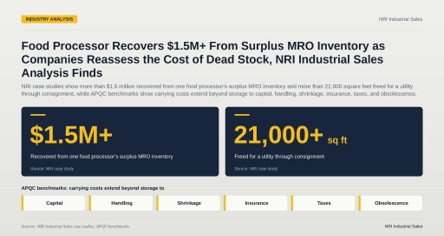
NRI case studies show more than $1.5 million recovered from one food processor’s surplus MRO inventory and more than 21,000 square feet freed for a utility through consignment, while APQC benchmarks show carrying costs extend beyond storage to capital, handling, shrinkage, insurance, taxes, and obsolescence.
DELTA, OH / ACCESS Newswire / November 18, 2026 / NRI Industrial Sales has released an analysis of its published surplus-recovery case studies, led by a food processing company that recovered more than $1.5 million from surplus maintenance, repair, and operations (MRO) inventory. The result is one project outcome published in NRI’s case-study library. It isn’t a benchmark for other companies or industries.
The analysis places the result alongside independent inventory-cost research from APQC, the Association for Supply Chain Management (ASCM), and the National Institute of Standards and Technology (NIST). Together, the sources show that idle industrial stock carries costs well beyond the shelf it occupies, and that the best way to recover value depends on a company’s priorities: speed, workload, space relief, ownership, and potential return.
A food processing company recovered more than $1.5 million from surplus MRO inventory
NRI’s public case-study library states that a food processing company recovered more than $1.5 million from surplus MRO inventory. The case-study index doesn’t disclose the client’s identity, the project dates, the starting book value of the inventory, or a recovery-rate methodology. For that reason, the figure shouldn’t be read as a percentage of original cost, a standard return, or an amount other manufacturers should expect.
The case shows that surplus MRO inventory, the spares, parts, and equipment kept on hand to maintain production can all hold recoverable value long after the original purchase decision. Whether any particular item can be sold depends on its condition, demand, quantity, and documentation. Not every obsolete item has resale value. Treating the figure as a case study (rather than a forecast) keeps the takeaway accurate and useful.
Two other NRI projects show the operational side of surplus
NRI’s case studies also report outcomes that aren’t measured in dollars. A large utility provider generated returns from idle inventory while freeing more than 21,000 square feet of storage space through consignment. Separately, NRI reports purchasing and removing more than 47,000 pieces of surplus MRO inventory and equipment following facility upgrades across an oil-and-gas client’s operations.
These are two distinct projects with different goals, and neither is combined here with the food processor’s result. The utility case illustrates space relief. The oil-and-gas case illustrates the scale and logistics that can build up when equipment transitions leave surplus behind. NRI hasn’t published a dollar value for the 47,000 items, and none is implied. Each figure describes one project, not a general benchmark.
APQC’s median carrying cost is $19 per $1,000 of revenue, and it covers more than storage
Independent research helps explain why idle inventory matters financially. APQC reports (October 2026) a median inventory carrying cost of $19 per $1,000 of revenue in a cross-industry benchmark covering 1,024 companies. The figure applies to inventory in general, not to surplus MRO specifically, so it shouldn’t be treated as an MRO benchmark.
APQC’s definition includes opportunity cost or cost of capital, storage space, insurance, taxes, inventory handling and administration, shrinkage, and total obsolescence. That framework keeps the conversation from shrinking to warehouse rent alone. Capital tied up in unused stock can’t be spent elsewhere, and obsolete items can lose value while they wait. When seen that way, a pallet of unused parts isn’t free to keep, even when it generates no invoice.
ASCM and NIST examples show how excess inventory affects operating costs
The ASCM Supply Chain Dictionary, 18th edition, describes carrying cost as capital cost plus taxes, insurance, obsolescence, spoilage, and occupied space, and notes that such costs can vary from 10% to 35% annually depending on industry. The range is broad and industry-dependent. It isn’t an annual cost estimate for MRO inventory or for any NRI client.
ASCM’s Petrobras case study offers a large-scale example. As part of an MRO and investment-materials transformation program, the company reported a 25% reduction in total inventory, a 34% reduction in excess inventory, and a 40% reduction in SKUs. ASCM says the broader program saved nearly $800 million in its first 18 months. Those savings reflect the whole program, not the sale of surplus inventory alone.
A National Institute of Standards and Technology, MEP success story, in 2026, adds a smaller manufacturing example. Vinton Steel revised its consumption factors and inventory controls and reported $155,000 in monthly savings, or $1.8 million annually, including cost avoidance from unnecessary excess purchases. It’s a separate case and isn’t directly comparable to NRI’s client results. It does show that excess-inventory decisions can affect real operating costs.
Direct purchase and consignment trade off speed, workload, and ownership
NRI Asset Recovery Solutions covers direct purchase, consignment, an Accelerated Surplus Program, channel-partner programs, auctions, and structured recovery for excess industrial inventory. The analysis doesn’t find that one model is better in every case.
Direct purchase generally prioritizes faster transfer, removal, and cash recovery. Consignment can extend the selling period and keep ownership with the consignor until a sale, while seeking broader market recovery. The exact economics depend on asset quality, urgency, volume, market demand, logistics, and contract terms.
A company facing a facility shutdown may weigh those trade-offs differently than one managing steady spares over several years. Neither model removes the need for the owner to confirm what is still needed internally before anything is offered for sale, since critical spares that look idle may still support production.
NRI Industrial Sales Pairs Recovery Models With Published Project Results
According to NRI, the company was founded in 2001 and is based in Delta, Ohio. Its history page says it surpassed $1 billion in managed inventory value in 2023. The company also reports freeing more than 25 million square feet of warehouse space, handling more than 1 million inventory items, and recycling 99% of materials. These are company-reported totals across all of its work. They aren’t independently verified and shouldn’t be applied to any single project.
NRI says its recovery models are supported by NRIParts.com and other buyer channels, and that its environmental-management framework follows ISO 14001. The company also reports an EcoVadis Sustainability Bronze Medal rating, a level that is client-supplied and was not independently confirmed for this analysis.
Methodology
NRI Industrial Sales synthesized publicly available surplus-recovery case studies and service pages with independent inventory-cost and supply-chain context from APQC, ASCM, and NIST. The primary finding is a company-published case study reporting more than $1.5 million recovered from surplus MRO inventory for a food processing company. Supporting NRI project outcomes include more than 21,000 square feet freed through utility consignment and more than 47,000 surplus assets purchased and removed in an oil-and-gas project. Independent sources are used to explain carrying-cost components and to show that excess inventory can create material financial and operational burdens in other industrial settings.
This analysis doesn’t use an unpublished NRI survey, a representative industry sample, or a causal study. NRI’s case-study index doesn’t disclose client identities, project dates, starting inventory book value, denominators, or a standardized recovery-rate methodology for the $1.5 million result, and none are assumed. No project result should be generalized into a guaranteed recovery percentage.
Frequently Asked Questions
What costs are included in holding obsolete or excess MRO inventory?
APQC’s definition includes capital tied up in inventory, storage, insurance, taxes, handling and administration, shrinkage, and obsolescence. The financial burden varies by company and industry. APQC’s $19 median per $1,000 of revenue is a cross-industry figure, and ASCM notes that annual carrying costs can range from 10% to 35% depending on the industry.
When does direct purchase make more sense than consignment for industrial surplus?
It’s a trade-off rather than a universal rule. Direct purchase generally prioritizes faster transfer, removal, and cash recovery. Consignment can extend the selling period and keep ownership with the consignor until sale, in pursuit of broader market recovery. The right choice depends on asset quality, urgency, volume, market demand, logistics, and contract terms.
How should companies identify surplus MRO inventory that still has recoverable value?
Start with asset data: manufacturer, part number, description, quantity, condition, location, demand, and criticality, along with whether the material is still needed internally. Not every obsolete item has resale value, and a documented inventory makes a realistic assessment possible.
How can surplus inventory affect warehouse operations?
Idle stock competes for storage capacity and adds handling and administrative burden. In NRI’s utility case, a consignment program freed more than 21,000 square feet of storage space. That’s one project’s outcome, and no standard space-savings percentage should be assumed.
What information should a business prepare before seeking an industrial asset-recovery proposal?
NRIs’ public process asks for equipment or inventory lists, photos where available, manufacturer and part details, quantities, condition, specifications, and location. The more complete the information, the more specific a proposal can be.
About NRI Industrial Sales
NRI Industrial Sales helps manufacturers and other industrial organizations recover value from surplus equipment, excess MRO inventory, project-end spares, and other idle assets. Its recovery models include direct purchase, consignment, off-site cataloging and warehousing, auctions, and structured asset-recovery programs. The company was founded in 2001 and is based in Delta, Ohio.
Media Contact
Source: NRI Industrial Sales
Contact: Aaron Lee
Email: aaron@nri-isd.com
Location: Delta, OH
SOURCE: NRI Industrial Sales
View the original press release on ACCESS Newswire


