California contributed 25.90% of total market revenue in 2025, supported by the state’s unrivaled vehicle population and ZEV mandate.
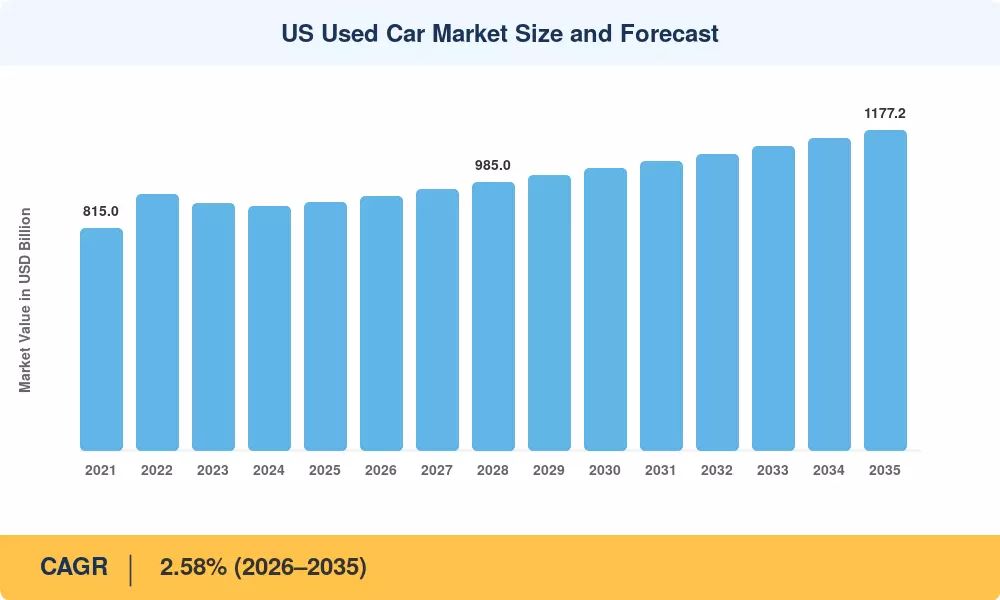
NEW YORK, NY, UNITED STATES, August 31, 2026 /EINPresswire.com/ — According to Market Research Future, the US Used Car Market is projected to reach USD 1,177.20 Billion, at a CAGR of 2.58% during 2026 to 2035, driven by Growing demand for electric vehicles in the Used Cars Market presents significant opportunities for dealers. This steady growth reflects the structural transformation of America’s automotive landscape, where used cars continue to outsell new vehicles by a substantial margin while undergoing a fundamental shift toward digital retail, certified pre-owned programs, and the emergence of battery-electric vehicles in the second-hand market .
Market Overview
The United States used car market represents one of the largest and most dynamic automotive segments globally, with annual transactions exceeding 36 million vehicles. The market is currently valued at approximately USD 1.05 trillion in 2025, with organised dealers controlling 51.27% of market share . The used car market is now approximately 1.5 to 2 times the size of the new car market in unit volume, serving as the primary pathway to vehicle ownership for millions of Americans . The US Used Cars Market is evolving rapidly as digital retail platforms and AI-powered pricing tools reshape the transaction experience, while the US Automotive AfterMarket adapts to an aging vehicle fleet and increasing vehicle complexity, with the aftermarket projected to grow 5.2% to USD 457 billion in 2026 .
The key growth drivers propelling this market expansion include the structural affordability gap between new and used vehicles, with new car prices reaching record highs and average monthly payments at historic levels. The average transaction price for a three-year-old vehicle stood at approximately USD 31,067 in Q3 2025, offering significant savings over new equivalents . The aging U.S. vehicle parc, with average vehicle age exceeding 12.5 years, creates sustained demand for pre-owned vehicles as owners extend ownership cycles . The expansion of certified pre-owned programs and manufacturer-backed warranties is building consumer trust and attracting buyers who might otherwise purchase new .
Technological developments are reshaping the used car landscape at an accelerating pace. Digital retail platforms now account for approximately 26% of used car sales, with online channels growing at a 7.19% CAGR . AI-powered pricing tools, 360-degree virtual tours, and online financing preapproval are becoming standard features of the shopping journey . The rise of omnichannel retail models, where buyers research online and purchase offline, is transforming dealer strategies and consumer expectations .
Market Segmentation
The US used car market is segmented based on vendor type, fuel type, body type, and sales channel to provide comprehensive insights into the industry landscape.
By Vendor Type: The market is categorized into Organized and Unorganized segments. Organized dealers controlled 51.27% of the United States used car market share in 2025 and are set to grow at a 7.41% CAGR through 2031 as scale enables bulk buying and rapid tech deployment . Large dealer groups leverage AI pricing, nationwide delivery, and omnichannel financing to improve inventory turns and customer reach. Unorganized dealers, while still significant, face increasing competitive pressure from digital platforms and certified pre-owned programs.
By Fuel Type: The market covers Gasoline, Diesel, Hybrid, and Battery Electric vehicles. Internal combustion engine vehicles constitute the largest share of sales, with consumers continuing to prefer ICE vehicles due to their long-standing familiarity, extensive availability, and established infrastructure for maintenance and refueling . Electric used vehicles are emerging as the fastest-growing category, fueled by increased consumer awareness of sustainability and the growing availability of models at varied price points . Factors such as improved battery technology, government incentives for EV purchases, and heightened environmental consciousness among consumers are driving this surge .
By Body Type: The market is segmented into SUVs and Crossovers, Sedan, Hatchback, and Others including trucks, vans, and coupes. SUVs and crossovers lead the US used car market with a 42.6% share in 2025, reflecting a multi-decade consumer migration away from sedans toward higher seating positions, all-wheel-drive capability, and family-friendly cargo space . Compact and mid-size models such as the Toyota RAV4, Honda CR-V, Ford Escape, Nissan Rogue, and Chevrolet Equinox consistently rank among the most-searched used models . Sedans hold 28.4% of unit volume and remain a critical entry-level and ride-hail category, with the Toyota Camry, Honda Civic, Honda Accord, and Toyota Corolla continuing to anchor the segment with strong residual values, fuel economy, and reliability ratings . Hatchbacks contribute 16.3%, supported by urban commuters and first-time buyers .
By Sales Channel: The market is divided into Offline and Online segments. Offline remains the dominant channel, though online channels are rising at a 7.19% CAGR as home delivery, digital paperwork, and virtual financing become standard parts of the shopping journey . The shift toward digital acquisition channels requires sophisticated customer relationship management to navigate challenges like interest rate sensitivity and post-pandemic price correction .
By Region: The market covers the United States, with regional analysis across major states.
🛒 You can buy this market report at:
https://www.marketresearchfuture.com/checkout?currency=one_user-USD&report_id=21771
Key Market Drivers and Trends
Electric Vehicle Emergence in the Used Market represents one of the most significant structural shifts. Used EVs are increasingly capturing attention, showing potential for growth as sustainable transportation becomes a priority for American consumers . The rising availability of used EVs is making it easier for consumers to enter the market, fueling its growth and challenging traditional fuel-powered segments . Consumers are increasingly attracted to used EVs as they are often priced lower than their new counterparts, making them a more accessible option for eco-conscious buyers . The 2020–2023 EV wave is now aging into the second-owner market for the first time, creating new inventory dynamics .
Digital Retail Transformation is reshaping how buyers and sellers transact. The used car search is almost entirely online, with 78% of buyers using sites like AutoTrader or Cars.com during their research process . Buyers spend over 14 hours researching before purchasing, making good photos and detailed listings more important than ever . Advanced dealer management systems and the automotive retail cloud are being deployed to manage inventory procurement volatility and optimize reconditioning workflows, with some operators reducing processing times by 15% .
Certified Pre-Owned Programs are building consumer trust and expanding the addressable market. Robust certified pre-owned programs offering manufacturer-backed certification, transparent vehicle history reports, and thorough multi-point inspections are core to building consumer trust . Franchise dealers often pay more for vehicles that qualify for CPO status (under 6 years old with fewer than 75,000 miles) because they can sell them at higher margins .
Market Challenges and Opportunities
The US used car market faces several key challenges that could impact growth trajectories. Inventory sourcing challenges continue to constrain supply, with lease returns projected to hit their lowest level since 2024 in early 2025 . The costs associated with floorplan inventory financing have risen over 25% for many dealers, creating financial pressure . Rising new vehicle prices have pushed average monthly payments to historic highs, which while driving demand for used alternatives, also affects affordability across the market . The 3–5-year-old inventory shortfall from the pandemic period continues to hold a price floor above trend, though it remains uncertain when this will unwind .
Emerging opportunities are abundant in the evolving automotive landscape. The growing demand for electric vehicles in the used market presents significant opportunities for dealers who establish credible EV resale frameworks, inspection protocols, and battery health certification programs . Online channels are expanding at a 7.19% CAGR, offering growth opportunities for digital-first platforms and dealers investing in omnichannel capabilities . The expansion of certified pre-owned programs and warranty assurance continues to build consumer confidence and attract new buyers to the used market . The shift toward subscription-based ownership models and flexible leasing options is expanding the addressable market .
To explore more market insights, visit us at:
https://www.marketresearchfuture.com/reports/us-used-car-market-21771
Final Market Summary
The US used car market is positioned for steady growth, driven by the affordability gap with new vehicles, structural inventory dynamics, and the accelerating emergence of electric vehicles in the second-hand market. The market’s trajectory to USD 1,177.20 Billion by 2035 reflects the continued importance of pre-owned vehicles in American personal mobility and the ongoing formalization of the used car ecosystem.
The long-term industry potential remains robust, with digital retail transformation, AI-powered pricing, and omnichannel strategies continuing to reshape the transaction experience. The convergence of used cars with broader mobility ecosystems, including certified pre-owned programs, online marketplaces, and electric vehicle resale frameworks, is creating comprehensive solutions that serve diverse buyer needs across demographic segments.
Key factors expected to influence future development include the pace of electric vehicle adoption, the evolution of inventory sourcing channels, and the advancement of digital retail capabilities. The development of transparent EV battery health certification, standardised inspection protocols, and credible resale benchmarks will accelerate electric vehicle acceptance in the used market. As consumers continue to prioritise value and affordability, the used car market will remain the dominant gateway to vehicle ownership for millions of Americans, ensuring sustained innovation and growth throughout the forecast period and beyond.
More Related Reports from MRFR Library:
Telecom Battery Market : https://www.marketresearchfuture.com/reports/telecom-battery-market-24282
Classic Car Market : https://www.marketresearchfuture.com/reports/classic-car-market-24502
School Bus Market : https://www.marketresearchfuture.com/reports/school-bus-market-26586
GCC Used Car Market : https://www.marketresearchfuture.com/reports/gcc-used-car-market-26890
Automotive Wire Market : https://www.marketresearchfuture.com/reports/automotive-wire-market-27650
Automotive Advertising Market : https://www.marketresearchfuture.com/reports/automotive-advertising-market-28651
Cruise Ship Market : https://www.marketresearchfuture.com/reports/cruise-ship-market-28964
Online Car Buying Market : https://www.marketresearchfuture.com/reports/online-car-buying-market-29780
Railcars Leasing Market : https://www.marketresearchfuture.com/reports/railcars-leasing-market-29885
Motorcycle Instrument Cluster Market : https://www.marketresearchfuture.com/reports/motorcycle-instrument-cluster-market-30858
Market Research Future
Market Research Future
+1 855-661-4441
email us here
Legal Disclaimer:
EIN Presswire provides this news content “as is” without warranty of any kind. We do not accept any responsibility or liability
for the accuracy, content, images, videos, licenses, completeness, legality, or reliability of the information contained in this
article. If you have any complaints or copyright issues related to this article, kindly contact the author above.

Media gallery