
Key Takeaways
- Google’s global search market share dropped below 90% for the first time in 10 years at the close of 2024, showing customers are splitting their searches across many more tools
- AI assistants like ChatGPT and Perplexity now name two or three businesses directly in an answer instead of offering a ranked list, so being described accurately matters more than ever
- Recent, detailed reviews carry more weight with AI tools than a large pile of old five-star ratings, making review recency a real ranking factor
- Apple Maps remains one of the most overlooked local search surfaces, even though it sits on every iPhone by default
- Three core assets, a complete Google Business Profile, a steady stream of detailed reviews, and plain-language website copy, feed almost every search surface customers now use
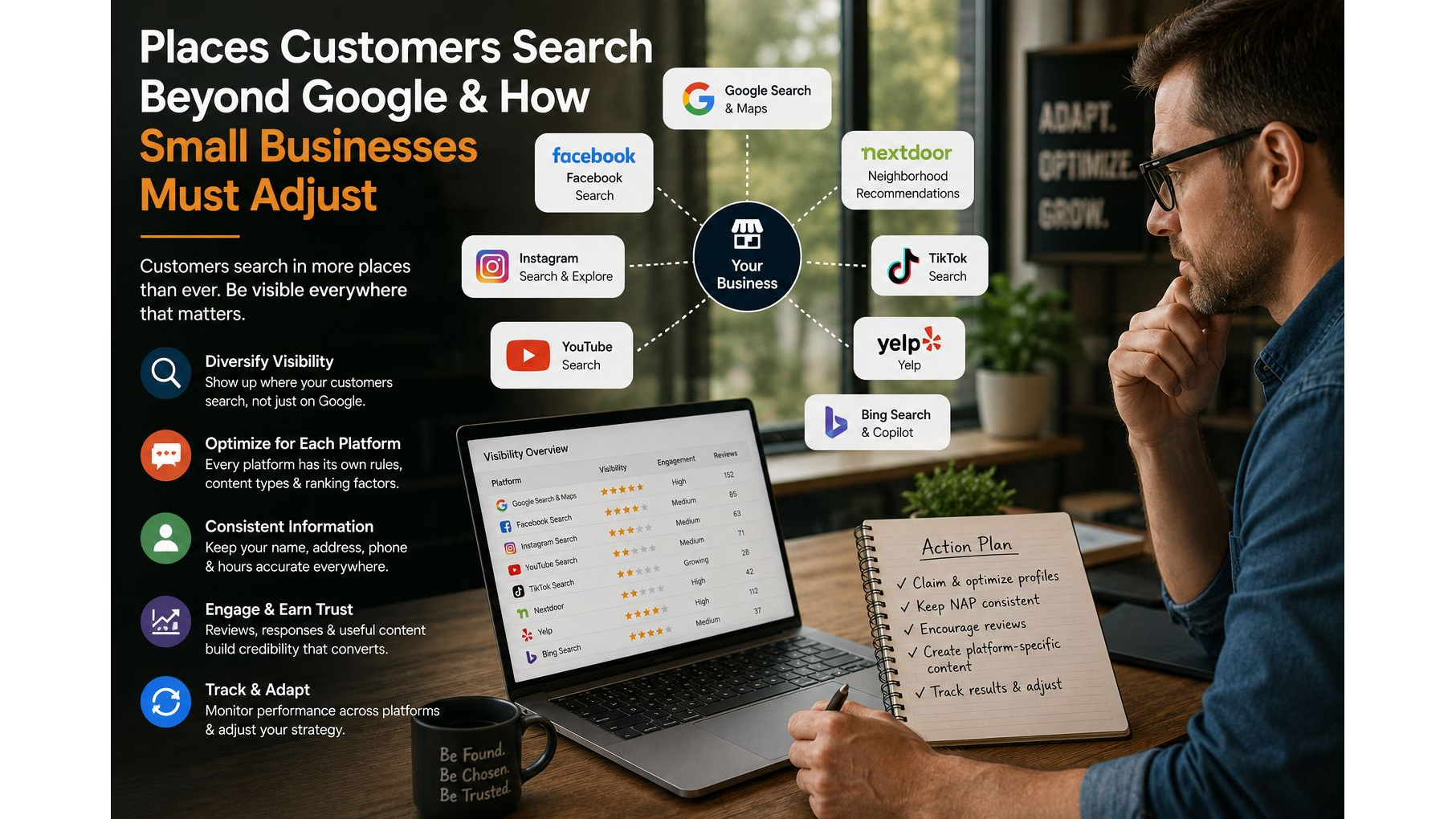
Search used to mean one thing: type a phrase into Google and pick from the list. That habit is breaking apart. Customers now ask AI assistants for recommendations, scroll Facebook groups, watch YouTube videos, and open map apps before they ever consider a traditional search engine. Small businesses that only pay attention to Google rankings are missing most of where their next customer actually is.
Google’s Search Share Hits 89.57%, a Ten-Year Low
Google’s global search market share dropped below 90% for the first time in 10 years at the close of 2024. That number sounds small, but Google has held near-total dominance in search for so long that any crack in the wall is worth noticing. The share leaving Google is not scattering randomly. It is flowing toward AI assistants, map apps, and social platforms that are becoming habitual starting points for specific kinds of questions, especially local ones like finding a repair service or a contractor nearby.
Profit Acuity points out that this fragmentation is exactly why a single-channel strategy no longer works for local businesses. Showing up in one place is no longer the same as showing up everywhere that matters.
AI Assistants Are the New Search Bar
Tools like ChatGPT, Gemini, and Perplexity have become active participants in local business discovery. They do not keep their own directory of local businesses. Instead, they read what is already public: a business’s Google Business Profile, its reviews, and its website copy, then stitch that information into a direct answer.
The use of AI for local recommendations grew from a small fraction of consumers to 45% of consumers in a single year, and many of those users say they trust an AI’s suggestion as much as a traditional review. That is a fast enough shift that a business absent from the data these tools read simply will not get mentioned.
What Makes a Business Legible to AI Tools
AI models weigh a handful of signals when deciding who to name in an answer:
- A complete, accurate Google Business Profile with correct categories and a defined service area
- Recent reviews written in plain language describing a real problem and its solution
- Website copy that matches how a homeowner actually talks, not just trade jargon
- Mentions on Reddit, Yelp, or local directories confirming the business name and location
- Any YouTube content the business has published with accurate titles and descriptions
Why Recent Reviews Outweigh Old Ones
AI tools treat review volume and recency as authority signals, and are considerably more likely to recommend a business with a strong flow of recent reviews than one coasting on an older reputation. A business with a steady trickle of new reviews this year will often outperform a competitor with hundreds of reviews that stopped coming in long ago. The words inside those reviews matter too, since specific phrases about the service become the raw material an AI uses to describe a business to the next person who asks.
Map Apps Are Now the Starting Point
Map apps used to be the last stop after someone found a business through search. Now they are often the first and only stop. A homeowner needing a plumber may open a map app, type the trade, and call whoever appears in the top few results without visiting a website at all.
Apple Maps deserves particular attention here. It is the default navigation app on every iPhone, yet a large share of local service businesses have never claimed their listing through Apple Business Connect. Since Apple Maps pulls its ratings from platforms like Yelp, TripAdvisor, and Foursquare rather than hosting its own reviews, keeping those third-party profiles current directly affects how a business appears on Apple’s map. Claiming and filling out that listing takes a small amount of effort and puts a business in front of a search surface most competitors are ignoring.
YouTube: The Search Engine Trades Ignore
YouTube processes more than 3 billion searches per month, making it the second-largest search engine in the world, yet most local trade businesses have no presence there at all. Homeowners frequently use YouTube to diagnose a problem before deciding whether to call a professional. A short video filmed on a job site that answers one specific question, with a business name and phone number in the description, can outperform a polished brand video that answers nothing in particular. In many local markets, searching a specific repair problem alongside a city name turns up zero results from local businesses, leaving an open lane for whoever fills it first.
Facebook, Nextdoor, and Reddit Run on Trust
Facebook neighborhood groups and Nextdoor operate on word-of-mouth at a larger scale than a single conversation ever could. A homeowner asking neighbors for a contractor recommendation is creating an open call that past customers either answer or do not. There is no way to buy a spot in that thread. The only lever a business controls is the quality of the work and the follow-up that keeps a happy customer willing to speak up when someone asks.
Reddit plays a related but different role. Research cited by Search Engine Journal found that Reddit accounts for roughly 21% of AI Overview citations, making it one of the largest external sources feeding the answers AI tools serve to searchers. That means conversations happening on Reddit about a trade or a specific business are already shaping what an AI recommends, whether or not a business ever posts there itself.
The Three Assets Every Surface Reads
Every platform covered so far, from an AI assistant to a Facebook recommendation thread, draws from the same small set of public records about a business. Strengthening three assets feeds nearly all of them at once.
Your Google Business Profile as the Foundation
A Google Business Profile is the single record that feeds the most search surfaces simultaneously. Google Maps reads it directly, AI tools scrape it as a primary source, and Apple Maps often cross-references it. Correct categories, a defined service area, current hours, and real job photos all make a profile easier for both people and algorithms to trust.
Reviews as Raw Material for AI Answers
Reviews have become more than a trust signal for the person reading them. They are the text AI tools use to describe a business, the recency signal map algorithms use to rank it, and the source material that surfaces when a neighbor asks for a recommendation. A review describing a specific problem and how it got fixed does far more work than a short, generic rating.
A Website Written in Plain Language
AI models read website copy the way they read reviews: as a source document. A homepage that clearly names the service, the location, and the exact problem it solves gives an AI tool something concrete to cite. Vague branding language leaves the tool with little to work with, no matter how nice it sounds to a human visitor.
Visibility Now Means Being Named, Not Ranked
Traditional search put a business in a ranked list and let the customer scroll. AI-assisted search skips that step, naming two or three businesses directly with no page two to fall back on. That shift changes what visibility actually means: having accurate, detailed, current information sitting in the places these tools already read matters more than climbing a results page.
None of this requires starting from scratch or juggling a dozen new platforms at once. Strengthening a Google Business Profile, building a steady flow of detailed reviews, and rewriting website copy in plain language will feed most of the surfaces discussed here at the same time. For a structured way to build that foundation, check out an authority content system built around the assets search tools already trust.
Profit Acuity
+1 877 624 1229
Concord Drive
Center Valley
PA
18034
United States


