Clinical Genomics Company, spun out of Human Longevity, adds integrated Alzheimer’s risk assessment and expands pharmacogenomics and wellness insights.
SAN DIEGO, CA, UNITED STATES, September 15, 2026 /EINPresswire.com/ — Simplify Genomics, the clinical genomics company built from genomic intelligence originally developed at Human Longevity, Inc. (HLI), today announced Version 10 of its Genomic Clinical Report (GCR). This version was developed within Simplify Genomics’ CAP-accredited and CLIA-certified laboratory, with new report content incorporated through the laboratory’s validated clinical reporting workflow and scientific evidence-review process.
Simplify Genomics was spun out of HLI in 2022, building on years of expertise in large-scale whole-genome analysis and clinical genomic interpretation. Today, the company advances that legacy through its Smart Genome™ platform, designed to make the genome a reusable source of clinical intelligence as scientific evidence and medical guidelines evolve.
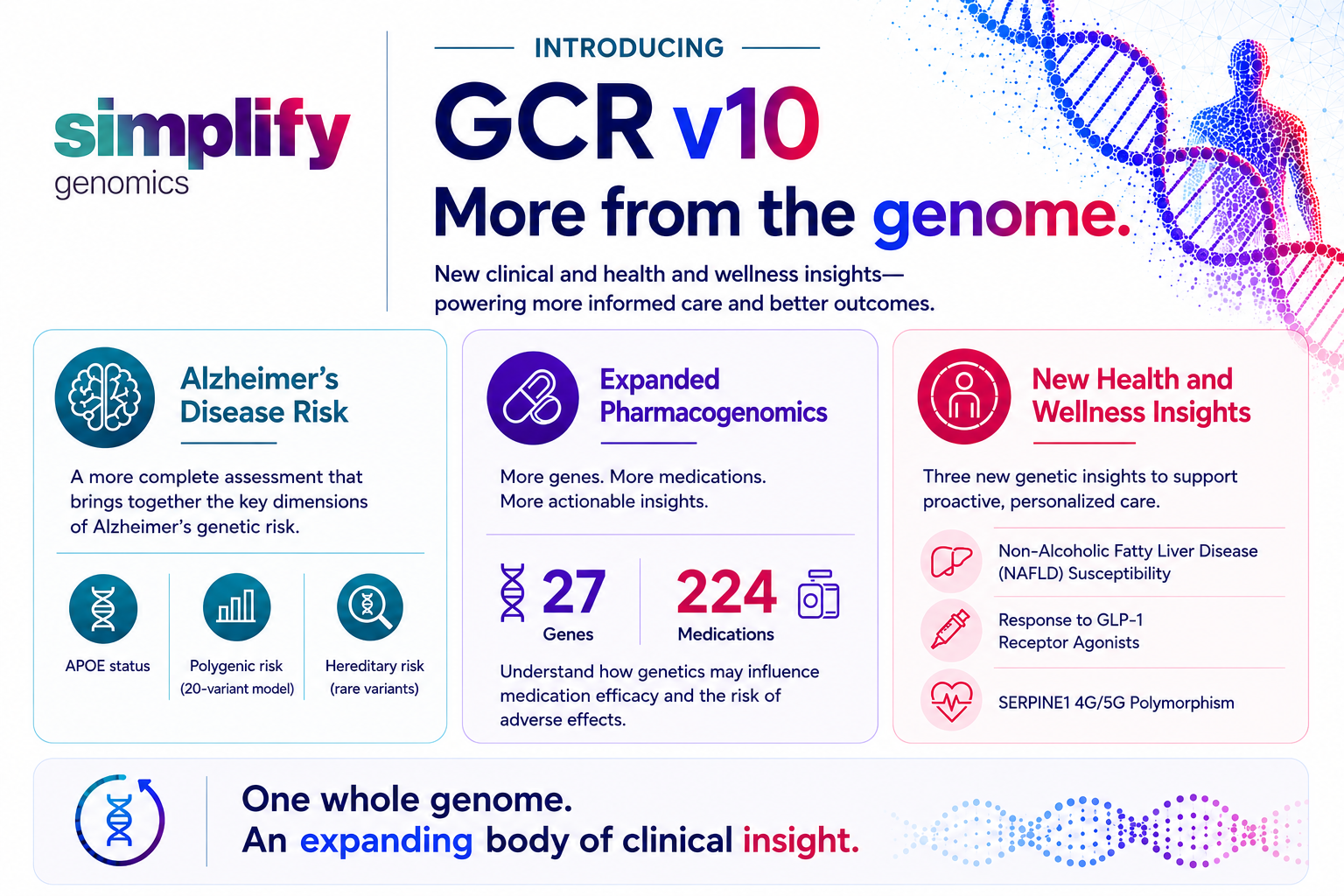
GCR v10 demonstrates that approach in practice. The new release introduces a dedicated Alzheimer’s Disease Risk assessment, expands pharmacogenomic analysis from 19 to 27 genes (135 to 224 medications), and adds three new wellness insights.
“Whole-genome sequencing gives us the opportunity to move beyond the traditional model of ordering a new genetic test every time a new clinical question arises,” said Travis Lacey, CEO of Simplify Genomics. “As genomic science advances, we can return to the genome and identify information that wasn’t available, well understood, or clinically relevant when it was originally sequenced. Version 10 demonstrates how that approach can continually expand the value of genomic information for patients and their physicians.”
A broader view of Alzheimer’s genetic risk
GCR v10 introduces a dedicated Alzheimer’s Disease Risk section that brings complementary dimensions of genetic risk into a unified assessment.
The new section reports phased APOE e2, e3 and e4 genotypes alongside a 20-variant polygenic risk score, providing physicians with additional context for understanding a patient’s genetic predisposition to late-onset Alzheimer’s disease.
Because the assessment is performed as part of whole-genome analysis, rare variants associated with hereditary forms of Alzheimer’s disease—including variants in genes such as APP, PSEN1, and PSEN2—can also be evaluated through the report’s hereditary disease analysis.
Together, these approaches provide a broader picture than APOE alone.
Pharmacogenomics expands to 224 medications
Version 10 substantially expands the report’s pharmacogenomic component.
New and expanded coverage includes PCSK9, OPRM1, CYP3A4, CFTR, F2, F5 and IFNL3, among others, extending pharmacogenomic insights across cardiovascular medicine, oncology, pain management and other therapeutic areas.
New PCSK9 content provides genetic context relevant to inherited lipid disorders and includes information on PCSK9-targeting therapies such as evolocumab, alirocumab, and inclisiran, while expanded opioid-related pharmacogenomics includes genetic associations relevant to medications including morphine and fentanyl.
The expanded assessment is designed to help healthcare teams understand how inherited genetic variation may influence medication response and risk of adverse effects.
New insights into GLP-1 response, liver health and cardiovascular risk
GCR v10 also introduces three new health and wellness insights derived from published genetic associations.
The new GLP-1 receptor agonist response assessment evaluates variants in GLP1R that published studies have linked to differences in glycemic and weight-loss response to GLP-1 receptor agonists.
The release also introduces genetic insights related to susceptibility to non-alcoholic fatty liver disease (NAFLD) and the SERPINE1 4G/5G polymorphism, which published studies have associated with risk for venous thromboembolism and myocardial infarction.
These findings are intended to provide information that physicians can consider alongside clinical history, laboratory results, lifestyle, and other risk factors.
Building a genomic baseline for lifelong interpretation
Unlike genetic panels designed to answer a specific question at a point in time, whole-genome sequencing creates a genomic baseline that can be revisited as scientific evidence and clinical guidelines evolve.
Simplify Genomics’ platform is designed around that model, enabling existing genomic data to be reanalyzed as new findings emerge.
“We’ve been working on the problem of whole-genome interpretation since our time at Human Longevity,” said Wayne Delport, Ph.D., CTO of Simplify Genomics. “What has become increasingly clear is that generating the genome is only the beginning. The patient’s genome hasn’t changed between version 9 and version 10. Our ability to understand and use it has. That’s the genomic intelligence layer we’re continuously building at Simplify.”
About Simplify Genomics
Simplify Genomics is a clinical genomics company providing whole-genome interpretation, reporting, and genomic intelligence through its Smart Genome™ platform. Simplify combines clinical whole-genome reporting with scalable genomic search and interpretation. Simplify Genomics operates a CLIA-certified, CAP-accredited laboratory. Learn more at simplifygenomics.com.
Travis Lacey
Simplify Genomics
email us here
Visit us on social media:
LinkedIn
Bluesky
X
Legal Disclaimer:
EIN Presswire provides this news content “as is” without warranty of any kind. We do not accept any responsibility or liability
for the accuracy, content, images, videos, licenses, completeness, legality, or reliability of the information contained in this
article. If you have any complaints or copyright issues related to this article, kindly contact the author above.

Media gallery