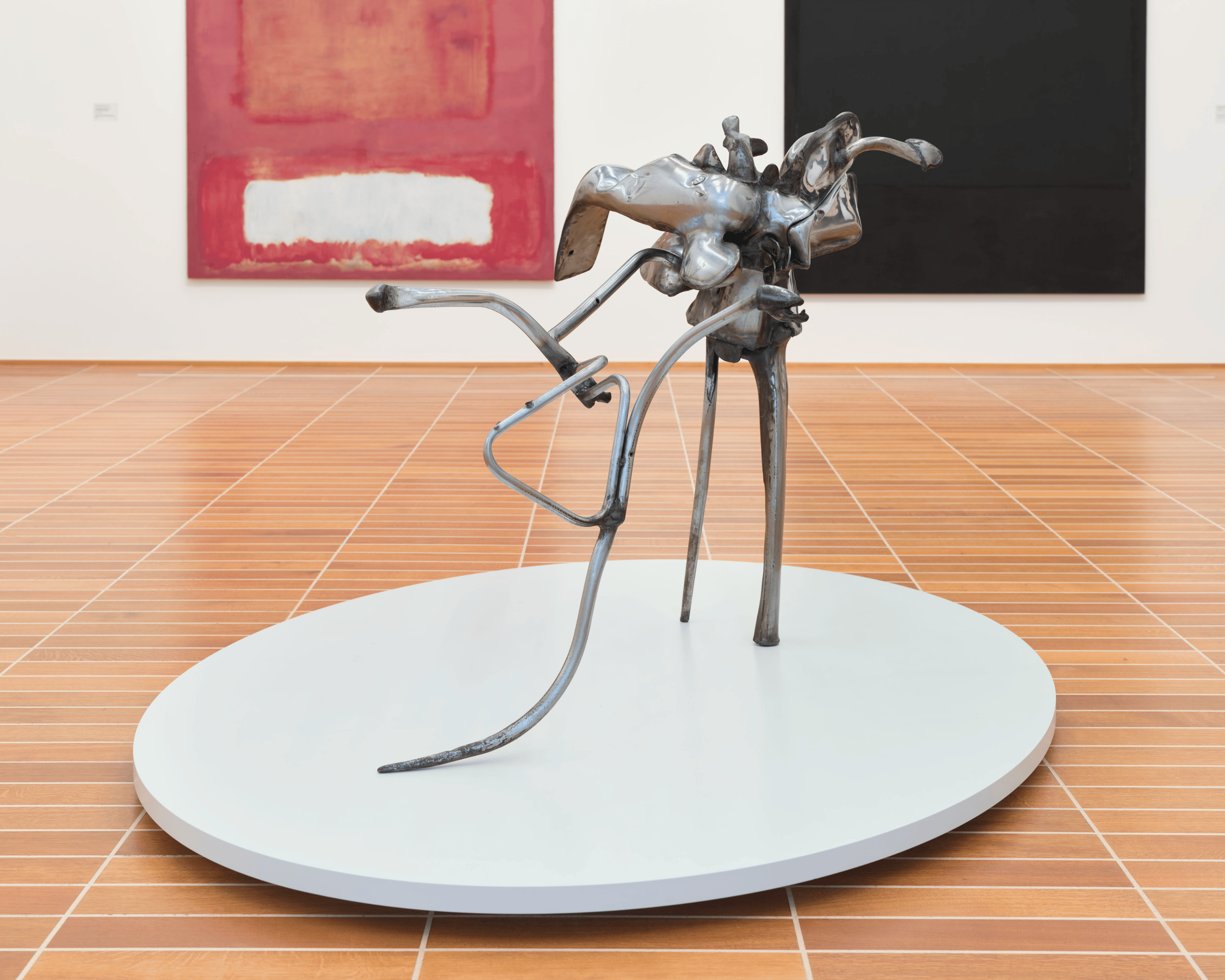
“Opposed Forms” is featured in the museum’s “Art after 1950” gallery among artists Clyfford Still, Mark Rothko, Hedda Sterne, Franz Kline, and other masters.
CHICAGO, IL, UNITED STATES, September 15, 2026 /EINPresswire.com/ — Kunstmuseum Basel (Switzerland) has acquired “Opposed Forms” (1965), a landmark welded chromed steel sculpture by the preeminent American artist Richard Hunt (1935–2023), into its Abstract Expressionism collection. The work is now on view in the museum’s “Art after 1950” collections gallery, joining mid-century masters. Widely considered one of the most important American sculptors, Hunt spent seven decades transforming rigid, industrial materials into weightless, biomorphic expressions of growth and metamorphosis. The acquisition of “Opposed Forms” secures a pivotal, museum-scale work from the height of the artist’s mid-century career.
“We are thrilled that Richard Hunt’s ‘Opposed Forms’ is entering the Kunstmuseum Basel’s collection,” states Elena Filipovic, Director of the Kunstmuseum Basel. “With this work, a pioneering sculptural voice enters the museum’s significant holdings of postwar American abstraction, long shaped by major works of artists Lee Bontecou, Franz Kline, Mark Rothko, and Clyfford Still, and allows us to tell the story of this period with greater depth and complexity. Hunt was one of the defining American sculptors of his generation, and ‘Opposed Forms’ makes his significance powerfully present in one of the oldest public art collections in the world.”
Kunstmuseum Basel joins esteemed European institutions such as The British Museum and Museum Moderner Kunst Stiftung Ludwig Wien (mumok)—along with more than 130 museums worldwide—in adding Hunt’s works to their permanent collections. At just thirty-five years of age, Hunt was the first African American sculptor to receive a solo retrospective at the Museum of Modern Art (MoMA), New York, in 1971, a historic exhibition that catapulted his pioneering open-form sculptures to international acclaim.
“We are honored to introduce European audiences to the powerful work of one of America’s greatest sculptors, helping to build a more complete and inclusive art history,” says Jon Ott, Executive Director of the Richard Hunt Legacy Foundation.
“Opposed Forms” represents a crucial stylistic milestone in Hunt’s oeuvre. In his Chicago studio, Hunt utilized salvaged chromed steel automobile bumpers and steel table legs reclaimed from local scrapyards. The work perfectly synthesizes Hunt’s early experimentation with linear-spatial “drawing in space” juxtaposed with volumetric, enclosed mass. This dynamic tension is manifested in a form that is at once fluid and muscular, evoking a Surrealist hybrid with metallic limbs, wing-like shapes, and stilted legs that suggest an other-worldly creature.
The exhibition history of “Opposed Forms” cements its place in twentieth-century art history. It was first exhibited in 1965 at Felix Landau Gallery. In 1966, the sculpture was selected as one of three works by Hunt to travel to Dakar, Senegal, to represent the United States at the historic First World Festival of Negro Arts (“Dix artistes nègres des États-Unis”–”Ten Negro Artists from the United States”)—a landmark international celebration of the global African diaspora. “Opposed Forms” was also featured in “Four Artists” at the Indiana University Art Museum in 1969; “Presage of Passage” at Brigham Young University Museum of Art in 1999–2000; “Richard Hunt: 60 Years of Sculpture” at the Chicago Cultural Center in 2015; and in two White Cube exhibitions—New York (2024) and London (2025). The work was most recently featured in “Richard Hunt: Pressure” at the Institute of Contemporary Art, Miami in 2025–2026.
###
About Richard Hunt
Richard Hunt (1935-2023) was a celebrated American metal sculptor who was the subject of more than 250 solo exhibitions, more than 500 group exhibitions, and featured as the first African American sculptor to have a retrospective at the Museum of Modern Art (MoMA) in 1971. His metal sculpture is notable for its widespread presence in more than 130 museum collections. Hunt made the largest contribution to public sculpture in the United States, with more than 160 commissions gracing prominent locations in 24 states and Washington, D.C.
Richard Hunt considered artistic freedom to be the most important aspect of his career: “I am interested more than anything else in being a free person. To me, that means that I can make what I want to make, regardless of what anyone else thinks I should make.”
Richard Hunt served on dozens of boards, committees, and councils during his lifetime, including serving as a Commissioner for the National Museum of American Art, part of the Smithsonian Institution, and as the first African American visual artist to serve on the National Council on the Arts. In addition, Hunt received more than 45 major awards, including the John Simon Guggenheim Memorial Fellowship, the Lifetime Achievement Award from the International Sculpture Center, the Fifth Star Award from the City of Chicago, and the Legends and Legacy Award from the Art Institute of Chicago.
Among his works, Hunt paid tribute to some of this nation’s greatest heroes, including Martin Luther King, Jr., Mary McLeod Bethune, Jesse Owens, Hobart Taylor, Jr., and Ida B. Wells-Barnett. In 2022, Hunt was the first artist to be commissioned to create a sculptural work for the Obama Presidential Center in Chicago. “Book Bird” (2023) now graces the Library Reading Garden outside the new Chicago Public Library branch on the Obama Presidential Center campus.
About the Richard Hunt Legacy Foundation
The Richard Hunt Legacy Foundation is a 501(c)(3) nonprofit organization that advances public awareness, education, and appreciation of the art and life of American sculptor Richard Hunt. The Richard Hunt Legacy Foundation’s vision is to ensure that future generations fully appreciate Richard Hunt by encouraging, inspiring, facilitating, educating, and supporting the public’s understanding of his work and his place in American and art history. In addition, the foundation aims to inspire the next generation of sculptors and artists.
www.richardhuntsculptor.org
Credit: Richard Hunt, “Opposed Forms,” Kunstmuseum Basel, acquired with funds from the Arnold Rüdlinger-Fonds der Freiwilligen Akademischen Gesellschaft, Basel 2026
Photos © 2026 The Richard Hunt Estate / Artists Rights Society (ARS), New York and Kunstmuseum Basel. Photo: Max Ehrengruber
Molly Ott
Richard Hunt Legacy Foundation
info@richardhuntsculptor.org
Visit us on social media:
Instagram
Facebook
YouTube
Legal Disclaimer:
EIN Presswire provides this news content “as is” without warranty of any kind. We do not accept any responsibility or liability
for the accuracy, content, images, videos, licenses, completeness, legality, or reliability of the information contained in this
article. If you have any complaints or copyright issues related to this article, kindly contact the author above.

Media gallery