GUANGYUAN, SICHUAN, CHINA, October 26, 2026 /EINPresswire.com/ — How do technical differences in manufacturing methods determine whether a wheel factory fits a specific fleet, wholesale catalog, or custom vehicle project? Across the automotive aftermarket, supply chain buyers constantly weigh unit cost against structural integrity. Cast wheel manufacturing remains a dominant choice for high volume automotive production due to lower tooling overheads and rapid cycle times. However, specialized applications such as high performance sport tuning, heavy duty off road setups, and tailored wheel programs frequently require higher load capacity and lower unsprung weight. Evaluating a high quality monoblock forged wheels factory from China alongside standard casting facilities reveals distinct operational trade offs, mechanical properties, and quality control paradigms for commercial procurement managers who seek reliable manufacturing partners.
Structural Integrity and Metallurgical Differences
The core distinction between monoblock forged wheels and standard cast wheels lies in material density and grain structure. Industry specialists at Guangyuan Anyu Aluminium Wheel Co., Ltd., (Syac), emphasize that raw material selection dictates long term mechanical durability under harsh road conditions.
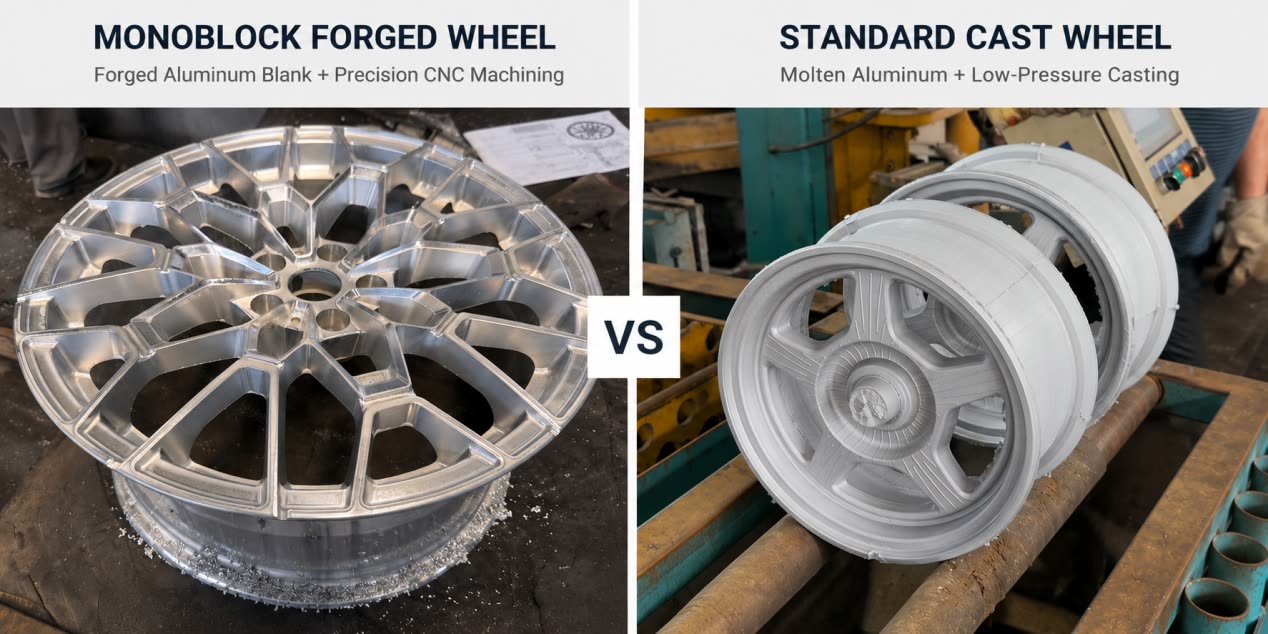
In standard casting operations, molten aluminum alloy (typically A356.2) is poured or low pressure injected into a static mold cavity. While modern low pressure casting reduces internal porosity compared to gravity casting, the solidified metal retains an isotropic, crystalline grain arrangement. Microscopic voids and gas pockets can naturally form during solidification. To maintain required load ratings, cast wheel designs must compensate by using thicker spoke profiles and heavier barrel walls.
Conversely, a monoblock forged wheels factory starts with a solid cylindrical billet of aerospace grade 6061 T6 aluminum alloy. Syac utilizes this dense material state to construct high strength wheel blanks through intense hydraulic pressing. Operating under hydraulic pressure reaching up to 10000 tons, the high pressure forging process compresses the aluminum, eliminating internal air pockets and aligning the metallurgical grain flow along the contours of the wheel profile. The result is a continuous grain structure that drastically increases tensile strength and yield strength. Because the forged material is substantially stronger per cubic millimeter, engineers at Syac machine thinner spokes and lighter rims without compromising structural safety.
Mechanical Performance and Dimensional Precision
Engineers evaluate automotive wheels through performance metrics including unsprung weight, radial fatigue resistance, impact tolerance, and dimensional runout.
Weight and Rotational Mass
Monoblock forged designs consistently reduce rotational inertia. By eliminating excess material, high quality monoblock forged wheels can weigh up to twenty to thirty percent less than an equivalent cast wheel of the same size and load capacity. Lower unsprung mass directly improves suspension response, shortens braking distances, and enhances acceleration dynamics.
Load Capacity and Fatigue Resistance
Under heavy dynamic loads, forged 6061 T6 alloy exhibits higher yield strength than cast aluminum. When subjected to severe impacts such as hitting potholes at high speeds, a cast wheel is prone to cracking due to its brittle crystalline structure. A monoblock forged wheel possesses higher ductility, meaning it tends to bend rather than fracture under extreme force. This provides an additional safety margin in high performance or heavy duty driving conditions.
Machining Precision and Balancing
Standard cast wheels rely on molded shapes with secondary CNC finishing on the mounting hub and lip. Draft angles and minor mold variations can create slight imbalances or runout variations across production batches. In contrast, high quality monoblock forged wheels are fully CNC machined from a forged blank. Lathes and multi axis milling centers cut every surface, center bore, bolt pattern, and spoke relief with micrometric precision. This level of machining accuracy results in tight dynamic balance tolerances, minimal radial runout, and consistent hub centering.
Traceability, Testing, and Quality Control Standards
For wholesale importers and brand owners, factory level quality assurance dictates product reliability and long term compliance.
Standard cast wheel factories operating at massive scale prioritize cycle speed. Quality checks typically rely on statistical batch sampling, where a designated percentage of wheels undergo X ray inspection to detect internal voiding, followed by standard dynamic radial and cornering fatigue testing.
A dedicated monoblock forged wheels factory operates under stricter, unit level quality control protocols. Because forged wheels serve premium or specialized markets, each forged blank undergoes initial ultrasonic flaw detection to ensure zero internal micro cracks before entering the CNC machining stage. Following multi axis milling, coordinate measuring machines verify dimensional accuracy against engineering CAD drawings.
Traceability is another key operational differentiator. Advanced manufacturing facilities assign serial identifiers to each forged billet, allowing technicians to track heat treatment lot numbers, machine operator logs, and inspection results throughout the manufacturing cycle. Quality testing protocols generally conform to recognized international standards such as VIA, JWL, TUV, and SAE J2530, ensuring that stress concentrations and load limits are rigorously validated prior to finish coating and shipment.
Manufacturing Capabilities at Syac
Navigating these technical requirements demands transparent engineering communication and controlled manufacturing processes. Operating out of Sichuan Province, Guangyuan Anyu Aluminium Wheel Co., Ltd. focuses on bridging the gap between design customization and manufacturing consistency.
Syac manages production workflows designed specifically to meet the strict tolerances required for forged applications. Utilizing prime 6061 T6 aluminum forging blanks, Syac applies precise multi axis CNC milling to translate custom vehicle fitment parameters including specific offset, center bore, bolt pattern, and brake clearance profiles into finished products.
Rather than relying solely on high volume standardized molds, Guangyuan Anyu Aluminium Wheel Co., Ltd. integrates custom engineering reviews into its workflow. Design engineers at Syac analyze stress distribution using finite element analysis software before cutting metal, ensuring optimal weight reduction while maintaining necessary load ratings. From initial raw billet inspection to final powder coating, hand brushing, or anodized surface treatment, Syac maintains documented quality checkpoints to support international distributors, tuners, and fleet operators who require verified structural performance.
Supply Chain Considerations and Sourcing Decisions
When selecting between a cast wheel manufacturing vendor and a monoblock forging partner, procurement managers must evaluate several operational variables:
Order Volume and Flexibility: Cast wheel factories typically enforce high minimum order quantities per mold to offset expensive tooling costs. A monoblock forged wheels factory utilizes CNC programming rather than fixed molds, making low volume orders, rapid prototyping, and bespoke fitment variations economically viable.
Vehicle Application: Daily drivers and standard passenger cars function reliably on cast wheels. High end sport vehicles, luxury SUVs, track cars, and heavy electric vehicles benefit significantly from the higher strength to weight ratio of forged aluminum.
Lead Times and Engineering Depth: Casting involves mold creation, which can lengthen initial development schedules. Forged manufacturing requires detailed CAD approval and precise CNC programming, placing a premium on clear technical communication between the buyer and the factory engineering team.
Choosing the right manufacturing partner ultimately depends on balancing cost requirements against physical performance demands. For businesses looking to expand their portfolio with tailored fitments and high strength wheel programs, partnering with a specialized factory provides the technical control needed to satisfy demanding market applications.
To review technical specifications, engineering capabilities, or product offerings, visit the official website at https://syacwheels.com/
Syac
Syac
Legal Disclaimer:
EIN Presswire provides this news content “as is” without warranty of any kind. We do not accept any responsibility or liability
for the accuracy, content, images, videos, licenses, completeness, legality, or reliability of the information contained in this
article. If you have any complaints or copyright issues related to this article, kindly contact the author above.

Media gallery