HANGZHOU, CN / ACCESS Newswire / April 17, 2026 / On April 16, DEEP Robotics, in collaboration with the Zhejiang Provincial Emergency Management Department, officially unveiled its embodied intelligent equipment-the AI Flood-Fighting Warrior-and conducted a live drill for geological hazard inspection in Shuichewu, Jingshan Town, Yuhang District, Hangzhou. The AI Flood-Fighting Warrior is China’s first embodied intelligent robot specifically designed for flood and typhoon prevention. It represents the first-generation, combat-ready embodied AI application for grassroots flood prevention patrols. Using DEEP Robotics’ Lynx M20 wheeled-legged robot as its mobile platform, it innovatively integrates large models and an onboard platform, and is equipped with a dual-spectrum pod, 5G module, edge computing unit, and other equipment. It can replace human personnel in performing core flood control tasks such as hazard inspection, danger reconnaissance, and personnel search and rescue, providing a reference for the intelligent transformation of grassroots flood and typhoon prevention.
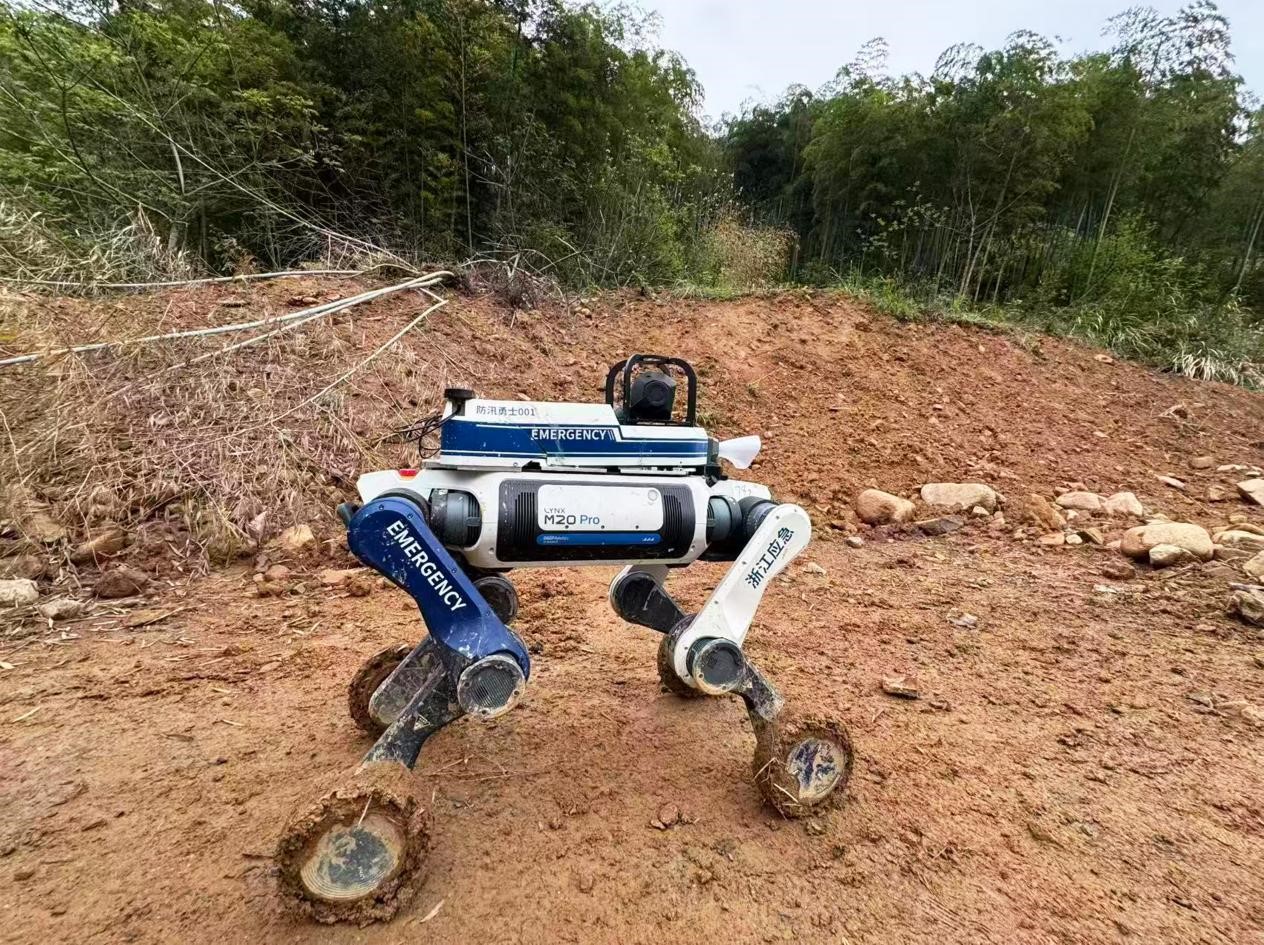
AI Flood-Fighting Warrior (DEEP Robotics Lynx M20 Quadruped Robot) Appears at the Live Geological Hazard Inspection Drill
Hazards Are Frequent in Mountainous Areas During Flood Season; Quadruped Robots Solve Flood Control Challenges
By mid-April, Zhejiang has officially entered the flood season, with a significant increase in the intensity and frequency of precipitation. Extreme weather such as typhoons and heavy rains can easily trigger geological disasters in mountainous areas, including landslides, falling rocks, fallen trees, and road collapses, posing a serious threat to the safety of people’s lives and property. For a long time, the traditional manual inspection model has faced numerous pain points: high-risk areas cannot be safely reached, hazard identification lacks precision, and emergency response efficiency lags behind, making it difficult to meet the operational requirements of grassroots flood prevention for “full coverage, precise early warning, and rapid response.”
DEEP Robotics, in collaboration with the Zhejiang Provincial Emergency Management Department, launched the AI Flood-Fighting Warrior quadruped robot, dedicated to solving the difficulties and bottlenecks of grassroots flood prevention and rescue. Through a live drill, they tested the intelligent equipment’s capabilities in traversing, perception, early warning, and rescue in real disaster scenarios, effectively improving the specialization and intelligence level of grassroots emergency response.
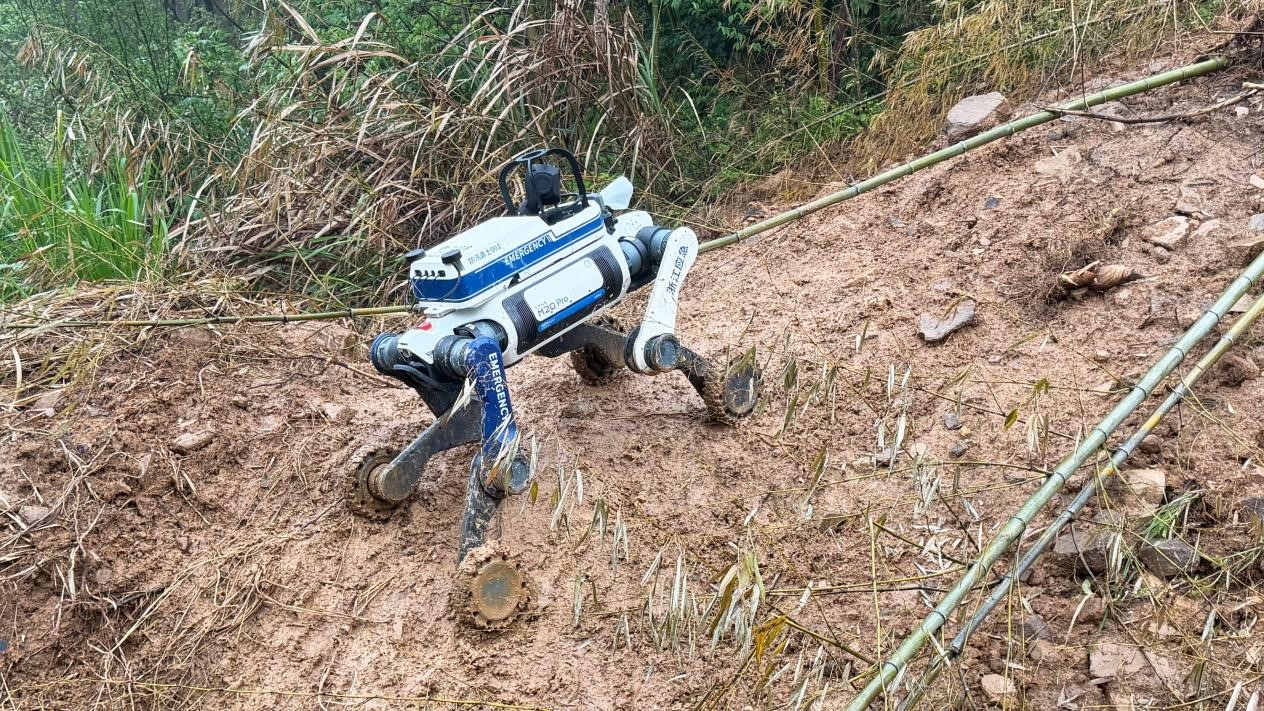
AI Flood-Fighting Warrior (DEEP Robotics Quadruped Robot) Climbs a Steep Landslide in a Mountainous Area
Routine Patrols on Mountain Roads: AI-Powered Identification of Geological Hazards
The drill realistically simulated typical hazards that may occur during the flood season, such as fallen trees and falling rocks on slopes. The “AI Flood-Fighting Warrior” robot dog penetrated the simulated accident site, relying on flood control AI algorithms and high-precision thermal imaging technology to build a comprehensive, intelligent hazard identification and emergency response system. Among its capabilities, the AI early warning system can accurately identify various flood control hazards such as fallen trees and roadbed collapses. It combines on-site actual conditions to assess risks and simultaneously transmits relevant data back to the command platform in real time, providing a scientific basis for hazard disposal. The system adopts an end-side integrated visual detection architecture, with the entire process running independently on the robot dog’s edge devices, significantly reducing reliance on the cloud and enabling real-time computation. This ensures system stability and guarantees low-latency early warnings, making hazard verification more accurate and timely.
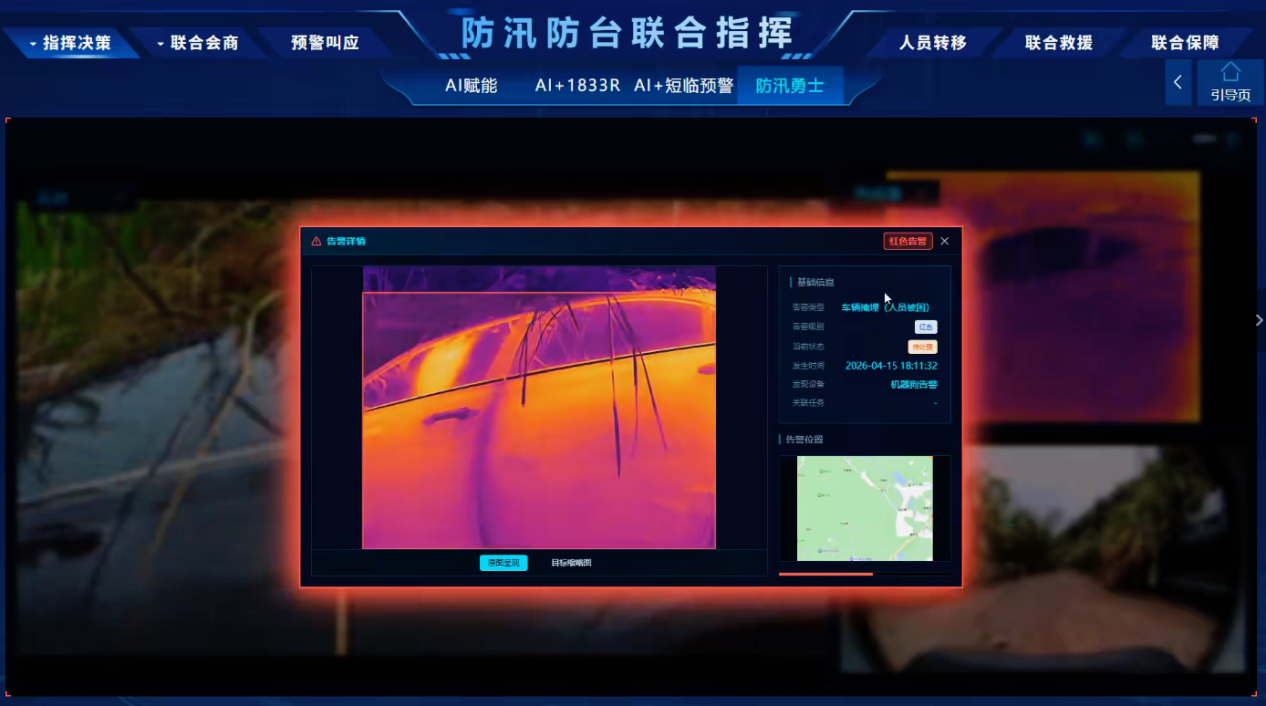
AI Flood-Fighting Warrior (DEEP Robotics Quadruped Robot) Transmits On-Site Images for Analysis
Full-Scenario Traversal of Complex Terrain: Communication Support for Every Hazardous Mile
During the flood season, mountain roads commonly suffer from mud, slippery surfaces, and scattered gravel, and face frequent challenges such as landslides and slope collapses. The “AI Flood-Fighting Warrior” robot dog, with its wheel-legged hybrid locomotion design, combines high mobility with exceptional obstacle-crossing capability. It can move steadily across complex terrain, easily climbing 45° slopes and wading through water up to 40cm deep, nimbly traversing harsh road conditions such as muddy sections, rubble piles, flooded areas, and landslide zones. In dangerous areas such as the core zone of a collapse where personnel cannot safely reach, the robot dog independently performs close-range reconnaissance, panoramic photography, data collection, and dynamic monitoring, effectively solving the pain points of traditional inspections that “cannot enter, cannot fully cover, and cannot accurately assess.”
Additionally, the emergency rescue vehicle is equipped with onboard communication satellite, providing multiple communication methods such as 5G and ad hoc networks. This ensures that even in areas with weak signals, the “AI Flood-Fighting Warrior” robot dog can transmit reconnaissance data in real time and receive precise commands from the backend.
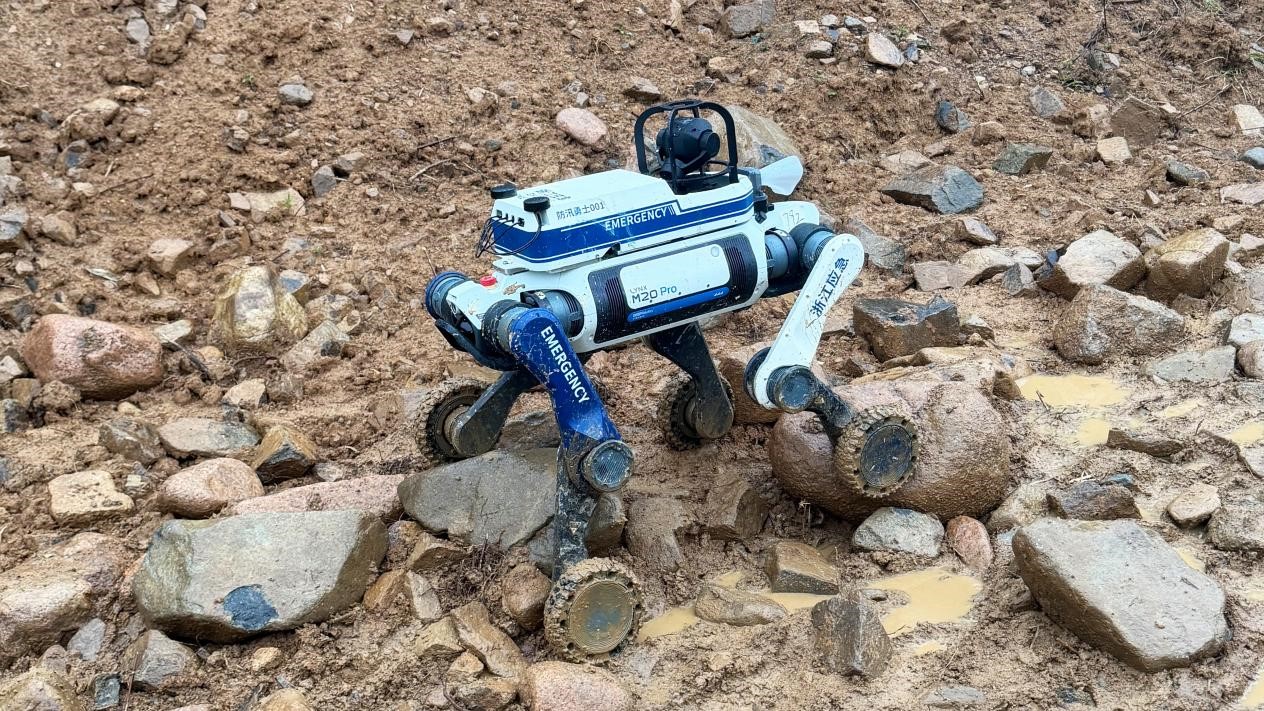
AI Flood-Fighting Warrior (DEEP Robotics Quadruped Robot) Traversing a Rubble Section
Tiered Early Warning and Intelligent Response: Building an Efficient Closed Loop for Emergency Disposal
During the flood season, there are many types of hazards with varying risk levels. Traditional manual reporting is often delayed and lacks standardized grade assessment, leading to slow responses, misallocated resources, and lost rescue opportunities. To address the need for tiered early warning and rapid response, the “AI Flood-Fighting Warrior” robot dog establishes a tiered early warning mechanism, creating a standardized and efficient emergency response process. When it identifies general hazards such as falling rocks on slopes, roadbed collapse, or fallen trees, the system automatically issues an orange early warning, uploading the information to the platform in real time with the hazard type and location marked. When major dangers such as a trapped vehicle or trapped person are detected, the system automatically escalates to a red early warning, simultaneously activating thermal imaging life detection. The command center then rapidly dispatches the nearest rescue forces based on the early warning level, truly achieving “early detection, early warning, rapid response, and quick disposal.”
Leveraging practical experience from over 1,200 scenarios, DEEP Robotics continuously iterates and upgrades the complex environment adaptability and autonomous intelligent decision-making capabilities of its core products, accelerating the large-scale deployment of technological achievements in public safety scenarios such as power inspection, security patrols, and emergency firefighting.
Company: DEEP Robotics
Contact: Vivian Chen
Email: chenlingjia@deeprobotics.cn
Website: https://www.deeprobotics.cn/en
SOURCE: DEEP Robotics
View the original press release on ACCESS Newswire


